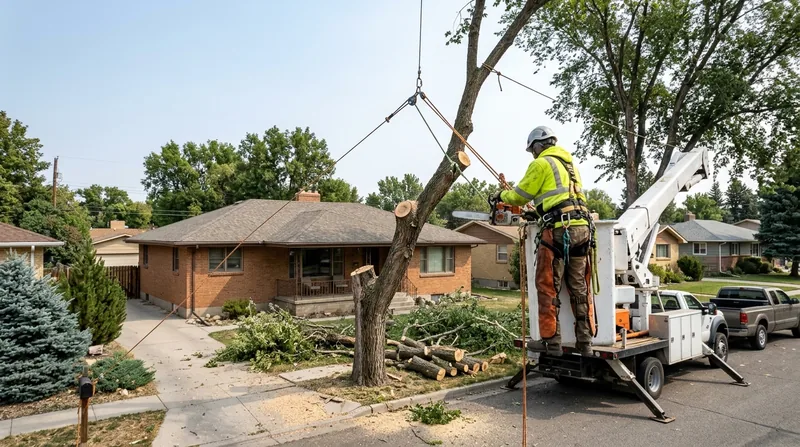




Billings sits in the Yellowstone River valley between the tall sandstone Rimrocks to the north and the river bottoms to the south, where big shade trees line the old grid streets of the North Elevation and newer subdivisions sprawl west toward Laurel. The city's mix of early-1900s brick foursquares, Craftsman bungalows, 1950s ranches, and 2000s two-story homes all share one thing in common: mature trees that need professional attention. Tree removal in Billings is not a DIY job when you're dealing with brittle Siberian elms, silver maples, or ponderosa pines near your roof, power lines, or fence. We remove hazardous, dead, and unwanted trees of any size with full rigging and crane access when needed, handling the complexity so you don't have to. Call us at (406) 500-6212 for a free estimate, or read on to understand why this service matters in our community.
Why Tree Removal Matters in Billings: Chinook Winds, Heavy Snow, and Brittle Wood
Billings experiences extreme seasonal stress on trees that older neighborhoods depend on for shade and privacy. Chinook wind gusts, heavy wet spring and early-fall snow on leafed-out trees, and dry hot summers create the perfect conditions for limb failure, especially in Siberian elms and silver maples that dominate the North Elevation and South Side. Dead or dying trees near homes, cars, and power lines become liability and safety hazards fast. Dutch elm disease, ash decline, and cytospora canker on spruce add to the problem. When a tree becomes a threat, removal is often the only safe and legal choice.
- We identify trees with structural weakness or disease that make them candidates for removal rather than treatment.
- We handle removals near homes, garages, and power lines with precision rigging to protect your property and utilities.
- We comply with local tree removal permits required in Billings and surrounding cities for trees above a set diameter.
- We work within protected heritage tree ordinances and HOA requirements that govern visible removals in many neighborhoods.
- We clear trees to restore sight lines, improve drainage, or eliminate pests and disease vectors on your land.
Understanding the local conditions and regulations that drive tree removal decisions protects both your safety and your property value.
Key info: Billings, Laurel, Lockwood, and Park City all require permits for tree removal above certain diameters. Check your city's ordinance before removing any large tree, or let us handle the paperwork and permitting as part of your job.
For more details on local regulations and protected trees, see the City of Billings municipal code, which governs tree removal in the 59101 and 59102 zip codes.
How We Remove Trees Safely in Billings: Step-by-Step Process
Tree removal in Billings requires more than a chainsaw and a truck. Our process starts with a detailed site assessment to understand the tree's size, species, health, proximity to structures, and access constraints. We then plan the removal method, secure any necessary permits, and execute the job with full safety protocols and equipment. We also offer stump grinding to complete the project and restore your yard.
- We inspect the tree for disease, structural defects, and hazards before we commit to a removal plan.
- We obtain permits from the city if required and coordinate with HOA or property management if applicable.
- We clear the work area and set up rigging points, crane access, or bucket truck positioning as the job demands.
- We fell or dismantle the tree in sections, controlling limb and trunk placement to protect nearby structures and utilities.
- We chip or haul all debris and clean up the site so your yard is ready for the next phase of your landscaping.
Every removal is tailored to the specific conditions on your property and the species we're working with.
Example: A 60-foot Siberian elm on a deep lot in the North Elevation near a brick foursquare might require rigging and a crane to lower limbs safely over the house. A 40-foot silver maple on a wide open lot in the Heights might be felled in one drop if the angle and ground clearance allow. We assess each tree individually and choose the safest, most efficient method for your situation.
Tree Removal Methods and Equipment We Use
Different trees and site conditions call for different approaches. Our crew is trained and equipped to handle every removal scenario, from simple felling on open land to complex rigging and crane work near homes and power lines.
| Approach | Description | Best for |
|---|---|---|
| Directional Felling | Cut the tree at the base and control its fall using wedges, ropes, and precise chainsaw cuts to guide it safely to the ground in a predetermined direction. | Open lots with clear drop zones, trees in good structural condition, minimal obstacle clearance needed. |
| Rigging and Lowering | Dismantle the tree into sections and lower each piece to the ground using ropes, pulleys, and anchor points to control descent and placement. | Trees near houses, garages, fences, or power lines where drop zones are limited or nonexistent. |
| Crane-Assisted Removal | Use a mobile or boom crane to lift large sections of the tree off the ground, allowing placement away from structures and utilities with precision and safety. | Large trees, confined spaces, high-value property protection, complex urban removals in Billings neighborhoods. |
| Bucket Truck Work | Climb and dismantle the tree from the top using a bucket truck to access upper limbs and trunk sections safely from an elevated platform. | Tall trees with limited ground clearance, urban lots, removal of specific limbs or hazards without full tree felling. |
Tree Removal Cost in Billings: What to Expect
Tree removal pricing in Billings depends on several concrete factors: the size and species of the tree, its proximity to your house or power lines, the accessibility of your yard, and the complexity of the removal method required. A small tree on an open lot costs far less than a 70-foot ponderosa pine on the Rims near your home or a large elm in a tight North Elevation lot. Getting two or three free estimates from insured contractors is the best way to understand the range for your specific job and make an informed decision.
We provide detailed estimates after an on-site inspection. Our pricing reflects the actual work involved, equipment needed, and local market conditions in Billings and the surrounding areas. For a full breakdown of our rates and what drives costs up or down, visit our pricing page. Call (406) 500-6212 to schedule your free estimate today.
Factors that increase removal cost:
- Tree height and trunk diameter (larger trees require more time, equipment, and rigging expertise).
- Proximity to structures, power lines, or utilities (complex rigging and crane work add labor and equipment costs).
- Tree species and wood density (hardwoods like oak and elm are heavier and slower to process than softwoods).
- Site access and yard conditions (narrow driveways, steep terrain, or limited turnaround space increase difficulty).
- Debris removal and site cleanup (full haul-off and chipping cost more than leaving chips on site).
Understanding these factors helps you see why estimates vary and why the lowest bid is not always the safest or most reliable choice.
What to Look for When Hiring a Tree Service Near Me in Billings
Choosing the right tree service protects your property, your neighbors' safety, and your wallet. Not all contractors are equally qualified or insured, and Billings homeowners deserve to know what to check before hiring. Look for fully insured contractors who carry liability coverage and workers' compensation, understand local permit requirements, and can provide references from recent work in your neighborhood.
Key things to verify:
- Confirm the contractor holds a valid business license and liability insurance covering tree removal and property damage.
- Ask for references from homeowners in Billings, Laurel, Lockwood, or Park City who had similar work done in the past year.
- Verify that the contractor understands local permit requirements for your city and tree size, and will handle permitting if needed.
- Discuss HOA rules or protected tree ordinances that may apply to your property before work begins.
- Get at least two written estimates that break down labor, equipment, debris removal, and any optional services like stump grinding.
- Check that the contractor has a clear safety plan and uses proper equipment like rigging gear, bucket trucks, or cranes appropriate to the job.
A professional contractor will answer all these questions clearly and provide documentation without hesitation. If you're ready to move forward, contact us for your free estimate and let us show you the difference that experience and professionalism make.
Tree Removal in Billings: Pricing Guide
| Service | Price | Details |
|---|---|---|
| Small Tree Removal | Starting at $400 | Trees up to 30 feet tall with clear access and simple felling to open ground area |
| Medium Tree Removal | Starting at $800 | Trees 30 to 60 feet with moderate rigging, proximity to structures, or limited drop zone access |
| Large or Complex Removal | On estimate | Trees over 60 feet, crane-assisted work, multiple hazards, or confined urban lots require site visit |
| Permit and Coordination | Included | We handle city permits, HOA approval, and utility coordination as part of the removal service cost |
| Free Estimate | No charge | On-site inspection and written estimate within 24 hours, no obligation to book the job |
Indicative pricing, the exact cost depends on square footage, finish, and site access. Free personalized estimate within 24h at (406) 500-6212.


